IMATの出題範囲・シラバス|2026年度の科目構成と日本語の要点

タグ・保存・共有
確認日:2026年11月5日。試験規定は2026/27年度の募集要項を基準にしています。2027/28年度の条件は、当該年度の公式要項で改めて確認してください。
この記事で分かること
※青字をクリックすると、読みたい項目に移動できます。
IMAT(International Medical Admissions Test)はイタリア国立医学部英語コースの筆記試験です。
IMATでは、論理的推論・判断推論、一般常識・英文読解、生物、化学、物理・数学といった幅広い科目を短時間(60問を100分)で解く必要があり、合格するためには徹底した入試対策が求められます。
しかし、IMATはイタリアの試験であるため、日本の医学部入試の試験範囲とは異なる部分も多々あり、出題される科目や分野、出題傾向・試験形式も異なります。
そのため、IMAT対策をする際に試験範囲を事前に知っておきたい場合もあるのではないでしょうか。
そこで今回は、最新版のIMATの試験範囲(シラバス)を各科目ごとにまとめました。試験範囲(シラバス)の英語訳のほか、日本語訳も載せているため、受験勉強をする際の参考にしてください。
IMATのシラバスを確認する際の注意点も紹介します!
それでは、本題に入ります。
IMATの試験概要とは?
IMATはInternational Medical Admissions Test と呼ばれるイタリア国立医学部英語コースの入学試験です。
試験形式はマークシート式による筆記試験であり、志望動機書や面接試験はありません。
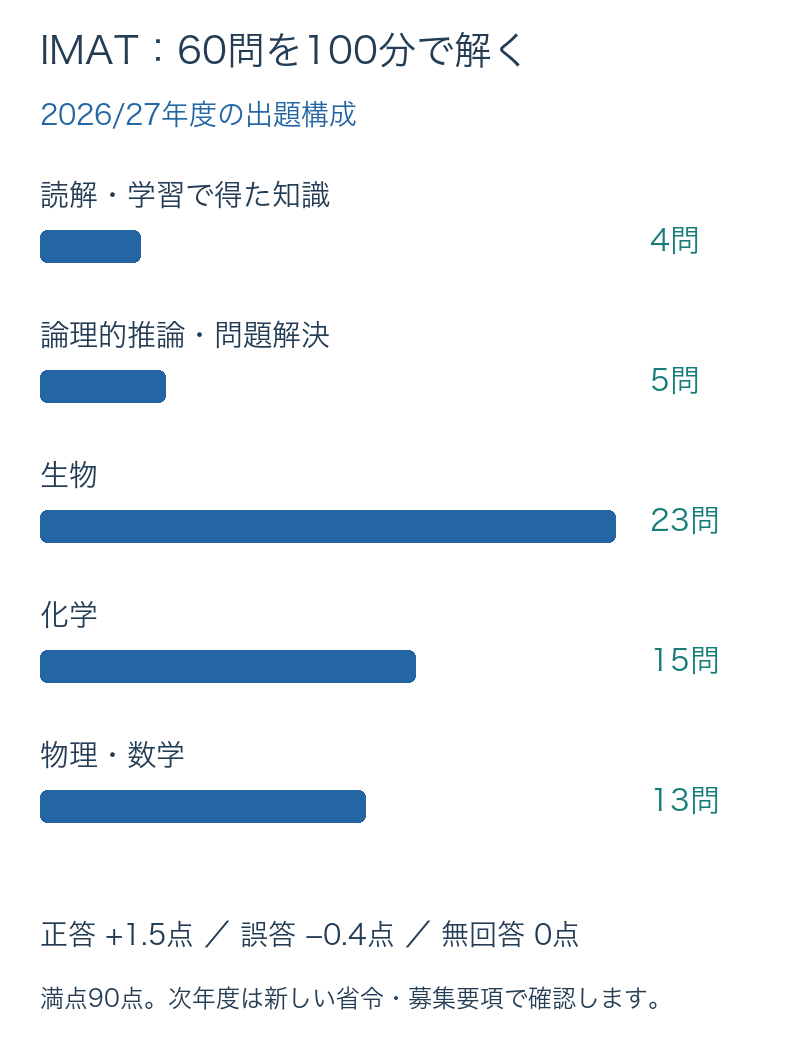
2026/27年度のIMATは2026年9月29日に実施され、問題は60問、試験時間は100分でした。読解・知識、論理、生物、化学、物理・数学の5区分から出題されました。
次年度の日程と科目配分は、受験年度の省令と大学の募集要項を確認してください。
採点は加点・減点方式であり、正答するごとに+1.5点、誤答を選ぶと-0.4点、未解答の場合だと0点です。科目や問題ごとに配点に違いはなく、満点は90点です。
2026/27年度のIMATの科目ごとの問題数は下記のとおりです(MUR 省令 2026年8月6日第1005号、ミラノ大学2026/27年度募集要項による。2026年10月10日確認)。
|
入試科目 |
問題数 |
得点 |
|---|---|---|
|
Reading comprehension and knowledge acquired during studies(英文読解・一般常識) |
4問 |
-1.6点〜+6.0点 |
|
Logical reasoning and problems(論理的推論・判断推論) |
5問 |
-2.0点〜+7.5点 |
|
Biology(生物) |
23問 |
-9.2点〜+34.5点 |
|
Chemistry(化学) |
15問 |
-6.0点〜+22.5点 |
|
Physics and Mathematics(物理・数学) |
13問 |
-5.2点〜+19.5点 |
|
合計 |
60問 |
-24.0点〜+90.0点 |
試験の得点は順位付けの基礎ですが、受験資格・受験枠・最低基準・同点時の規定・入学手続きも満たす必要があります。IMATの合否の決まり方と正規合格・繰上合格の詳細は下記記事で解説しています。
https://mirunote.com/exam/imat/
IMATのシラバス(出題範囲)まとめ
最新版のIMATのシラバス(出題範囲)を科目ごとにすべてまとめました。原文はイタリア語であるため、本記事では独自に英語・日本語に翻訳しました。
- Reading skills and knowledge acquired during studies(英文読解・一般常識)
- Logical Reasoning & Problem Solving(論理的推論・判断推論)
- Biology(生物)
- Chemistry(化学)
- Physics (物理)
- Mathematics(数学)
それぞれの科目ごとの出題範囲をまとめました。
Reading skills and knowledge acquired during studies(英文読解・一般常識)
|
出題分野 |
出題分野(日本語) |
|---|---|
|
Comprehension of written English texts of different genres and communicative purposes |
多様なジャンル・目的の英文読解 |
|
Understanding abstract, uncommon, or specialised vocabulary in real contexts |
抽象的・珍しい・専門語彙の文脈理解 |
|
Identifying textual cohesion and coherence |
テキストの結束性・論理展開の把握 |
|
Extracting and inferring specific information from a text |
具体情報の抽出と推論 |
|
Reading short scientific essays, classic/contemporary fiction, and current-affairs articles |
科学エッセイ・古典/現代小説・時事記事の読解 |
|
Orienting historical and cultural phenomena in space and time |
歴史・文化事象を時空間に位置づける力 |
|
Knowledge of major national and international institutions |
国内外主要機関に関する知識 |
|
Understanding issues in law, economics, and citizenship |
法学・経済・市民社会の諸課題の理解 |
Logical Reasoning & Problem Solving(論理的推論・判断推論)
|
出題分野 |
出題分野(日本語) |
|---|---|
|
Completing a logical argument consistent with given premises |
与えられた前提を踏まえて論証を完成させる力 |
|
Symbolic or verbal premises on concrete or abstract cases |
記号的・言語的前提に基づく具体/抽象ケース |
|
Using diverse forms of logical reasoning to reach a solution |
多様な論理思考を用いた問題解決 |
Biology(生物)
|
出題分野 |
出題分野(日本語) |
|---|---|
|
Chemistry of living organisms |
生体化学 |
|
Biological importance of weak interactions |
弱い相互作用の生物学的重要性 |
|
Organic molecules and their functions; role of enzymes |
生体有機分子と機能・酵素の役割 |
|
Cell as the basis of life; cell theory; cell size |
生命の基本単位としての細胞・細胞説・細胞の大きさ |
|
Prokaryotic and eukaryotic cells (animal/plant); viruses |
原核細胞・真核細胞(動物・植物)・ウイルス |
|
Cell membrane: structure, functions, transport |
細胞膜の構造・機能・物質輸送 |
|
Cellular structures and specific functions |
細胞小器官と各機能 |
|
Cell cycle and division: mitosis, meiosis, karyotype, maps |
細胞周期と分裂(有糸・減数)、染色体、マップ |
|
Reproduction and heredity; life cycles; sexual/asexual |
生殖と遺伝・生活環・有性/無性生殖 |
|
Mendelian genetics: laws and applications |
メンデル遺伝学:法則と応用 |
|
Classical genetics: chromosomal theory, inheritance models |
古典遺伝学:染色体説・遺伝様式 |
|
Molecular genetics: DNA structure/replication, code, protein synthesis, gene regulation |
分子遺伝学:DNA構造・複製、遺伝暗号、タンパク質合成、遺伝子制御 |
|
DNA of prokaryotes; eukaryotic chromosome structure |
原核生物DNA/真核染色体構造 |
|
Human genetics: mono-/polyfactorial traits; autosomal & X-linked diseases |
ヒトの遺伝:単因子・多因子形質;常染色体/X連鎖疾患 |
|
Mutations; natural & artificial selection; evolutionary theories; genetic basis of evolution; heredity vs environment |
突然変異・自然/人工選択・進化論・進化の遺伝的基盤・遺伝と環境 |
|
Biotechnology: recombinant DNA technology & applications |
バイオテクノロジー:組換えDNA技術と応用 |
|
Anatomy & physiology of animals and humans; animal tissues |
動物・ヒトの解剖生理;動物組織 |
|
Human systems and apparatuses; interactions; homeostasis |
ヒトの器官系と相互作用・恒常性 |
|
Bioenergetics: ATP, redox reactions, photosynthesis, glycolysis, aerobic respiration, fermentation |
生体エネルギー学:ATP、酸化還元、光合成、解糖、好気呼吸、発酵 |
Chemistry(化学)
|
出題分野 |
出題分野(日本語) |
|---|---|
|
Constitution of matter: states, heterogeneous/homogeneous systems, compounds, elements |
物質の構成:状態・異種/均質系・化合物・元素 |
|
Ideal gas laws |
理想気体の法則 |
|
Atomic structure: particles, atomic/mass numbers, isotopes, electron configuration |
原子構造:原子を構成する粒子・原子番号/質量数・同位体・電子配置 |
|
Periodic system: groups, periods, transition elements; periodic properties |
周期表:族・周期・遷移元素;周期的性質 |
|
Chemical bond: ionic, covalent, metallic; bond energy, polarity, electronegativity, intermolecular forces |
化学結合:イオン・共有・金属結合;結合エネルギー・極性・電気陰性度・分子間力 |
|
Inorganic chemistry fundamentals: nomenclature & properties of oxides, hydroxides, acids, salts |
無機化学基礎:酸化物・水酸化物・酸・塩の命名と性質 |
|
Chemical reactions & stoichiometry: atomic/molecular mass, Avogadro’s number, mole, balancing, reaction types |
化学反応と量的計算:原子/分子量、アボガドロ数、モル、反応式係数、反応型 |
|
Solutions: water as solvent, solubility, concentration expressions |
溶液:水の溶媒特性・溶解度・濃度表示 |
|
Equilibria in aqueous solution |
水溶液の平衡 |
|
Chemical kinetics & catalysis |
反応速度論と触媒 |
|
Oxidation–reduction: oxidation number, oxidant/reductant, balancing |
酸化還元:酸化数・酸化剤/還元剤・反応調整 |
|
Acids and bases: concepts, pH, hydrolysis, buffer solutions |
酸・塩基:概念、pH、加水分解、緩衝液 |
|
Organic chemistry basics: C–C bonds, empirical & structural formulas, isomerism |
有機化学基礎:炭素結合、分子式/構造式、異性体 |
|
Hydrocarbons: aliphatic, alicyclic, aromatic |
炭化水素:脂肪族・脂環式・芳香族 |
|
Functional groups: alcohols, ethers, amines, aldehydes, ketones, carboxylic acids, esters, amides |
官能基:アルコール、エーテル、アミン、アルデヒド、ケトン、カルボン酸、エステル、アミド |
|
Elements of organic nomenclature |
有機命名法の基本 |
Mathematics(数学)
|
出題分野 |
出題分野(日本語) |
|---|---|
|
Number sets & algebra: natural, integer, rational, real numbers; operations; scientific notation; proportions; percentages |
数体系と代数:自然数・整数・有理数・実数;演算;科学的記数法;比・百分率 |
|
Exponents, radicals, logarithms; combinatorial calculus |
指数・根号・対数;組合せ計算 |
|
Algebraic expressions & polynomials; notable products; binomial theorem; factorisation |
単項式と多項式;展開公式;二項定理;因数分解 |
|
Algebraic fractions; first/second-degree equations & inequalities; systems |
分数式;一次/二次方程式・不等式;連立方程式 |
|
Functions: definitions, graphs, domain/codomain, sign, continuity, extrema, monotonicity |
関数:定義・グラフ・定義域/終域(codomain)・符号・連続性・極値・増減 |
|
Elementary functions: rational, exponential, logarithmic, trigonometric |
初等関数:有理関数、指数関数、対数関数、三角関数 |
|
Composite & inverse functions |
合成関数・逆関数 |
|
Trigonometric equations & inequalities |
三角方程式・三角不等式 |
|
Geometry: polygons, circle; length/area/volume; transformations; loci |
幾何:多角形・円;長さ・面積・体積;変換;軌跡 |
|
Angle measurement (degrees, radians); sine, cosine, tangent, notable values |
角度(度・ラジアン);三角比と主要値 |
|
Trigonometric identities; triangle solving |
三角恒等式;三角形の解法 |
|
Cartesian plane: distance, midpoint, line equation; parallelism & perpendicularity |
座標平面:距離・中点・直線方程式;平行・垂直条件 |
|
Conic sections: circle, parabola, hyperbola, ellipse |
円錐曲線:円・放物線・双曲線・楕円 |
|
Pythagorean theorem; Euclid’s theorems |
ピタゴラスの定理;ユークリッドの定理 |
|
Probability & statistics: frequency distributions, graphs, random experiments, probability |
確率・統計:度数分布・図示・試行・確率 |
Physics(物理)
|
出題分野 |
出題分野(日本語) |
|---|---|
|
Physical quantities & measurement: fundamental/derived units, SI & technical systems, prefixes, scientific notation |
物理量と計測:基本/派生単位、SI/技術単位系、接頭語、科学記数法 |
|
Scalars & vectors; vector operations |
スカラー量・ベクトル量;ベクトル演算 |
|
Kinematics: motion description, velocity & angular velocity, acceleration, centripetal acceleration; uniform rectilinear, uniformly accelerated, uniform circular, harmonic motion |
運動学:運動記述、速度・角速度、加速度・向心加速度;等速直線・等加速度・等速円運動・単振動 |
|
Dynamics: forces as vectors, inertia, mass, Newton’s laws, weight, elastic force, friction, impulse, momentum, conservation laws, work, kinetic & potential energy, mechanical energy, power |
力学:力のベクトル、慣性、質量、ニュートン法則、重力、弾性力、摩擦、衝撃量、運動量、保存則、仕事、運動エネルギー・位置エネルギー、力学的エネルギー、仕事率 |
|
Fluid mechanics: density, compressibility, hydrostatics (pressure, Pascal, Stevin, Archimedes), fluid dynamics (continuity, Bernoulli), viscosity |
流体力学:密度・圧縮性;静水学(圧力、パスカル、スティビン、アルキメデス);流体力学(連続の式、ベルヌーイ);粘性 |
|
Thermodynamics: temperature, heat, calorimetry, heat transfer, heat capacity, state changes & latent heat, ideal gas laws, 1st & 2nd laws |
熱力学:温度、熱量、熱量測定、熱伝達、熱容量、相変化・潜熱、理想気体法則、熱力学第1・第2法則 |
|
Electricity & electromagnetism: electric charge, Coulomb’s law, field, potential, dielectric constant, capacitance, capacitors (series/parallel), electrostatic energy, generators, voltage, current, resistivity, resistance (series/parallel), Ohm’s law, Kirchhoff’s laws, work, power, Joule effect, DC/AC, period & frequency, magnetic field of a current, forces on currents, electromagnetic induction |
電磁気学:電荷、クーロン法則、電場、電位、誘電率、容量、コンデンサ(直列・並列)、静電エネルギー、起電力、電圧、電流、抵抗率、抵抗(直列・並列)、オームの法則、キルヒホッフ則、電気仕事・電力・ジュール熱、直流/交流、周期・周波数、電流の磁場、磁場中の電流に働く力、電磁誘導 |
IMATのシラバス(出題範囲)の注意事項
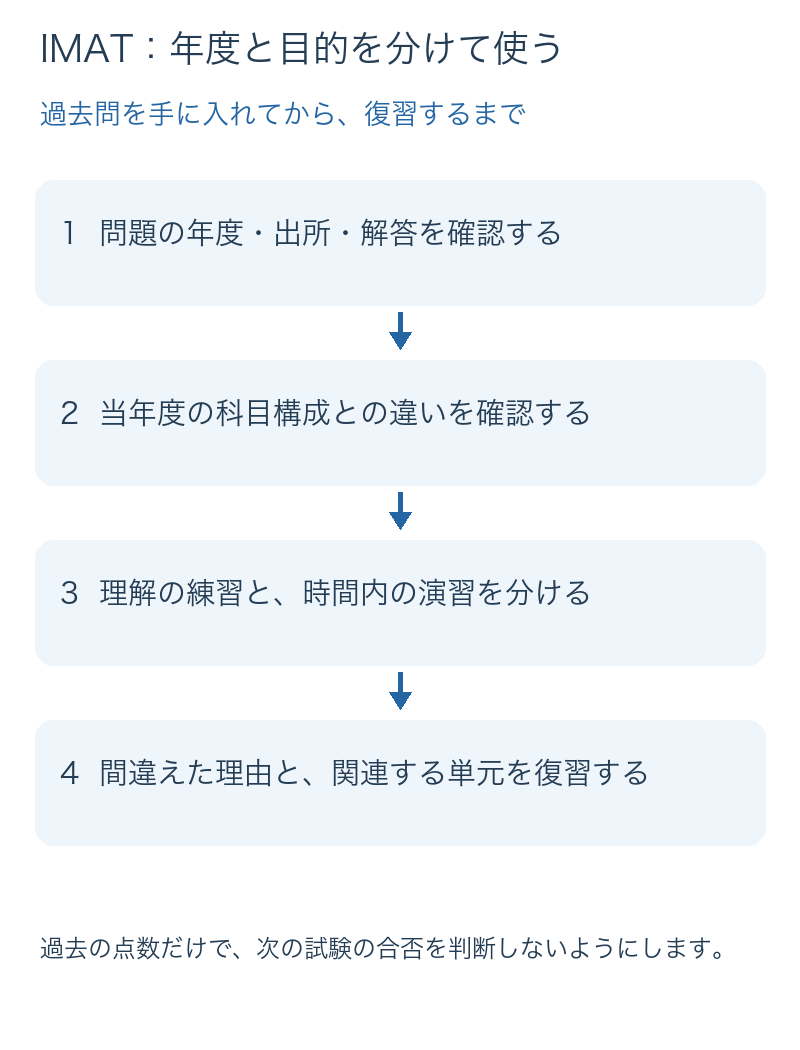
IMATのシラバス(出題範囲)はあくまで出題する可能性がある分野を列挙したものであって、これらの範囲がすべて出題されるわけではありません。
IMATの受験対策では、シラバスで必要な範囲を確認したうえで、過去問や問題演習を使って優先順位を付けることをオススメします。
過去問でよく出る分野だけに絞り、公式の出題範囲にある未学習の単元を放置しないようにしてください。
シラバスはあくまでも何を勉強すべきかの概要を掴むために利用してください。
IMATの頻出問題や知っておくべき解法パターンは、過去問を解いて確認するのが近道です。mirunoteの問題演習(exam.mirunote.com)でIMAT形式の問題を確認できます。科目別の勉強法は下記のページでまとめています。
https://mirunote.com/med-entrance/imat/
まとめ:IMATのシラバスを確認して入試対策を始めよう
今回は、IMATのシラバス(出題範囲)と注意事項について紹介しました。
日本の医学部入試などと同様に、大学入試で出題されるシラバスは一応はありますが、このシラバスから満遍なく問題が出題されるということではありません。
IMATでは出題傾向に偏りがあり、出題される問題パターンや問われる出題分野が毎年同じであるというものもあります。
シラバスを眺めるだけでなく、過去問や問題演習で頻出分野と解き方を確認しながら、IMAT対策をおこなうことをオススメします。科目別の勉強法は下記のページでまとめています。
https://mirunote.com/med-entrance/imat/
「独学ではIMATに合格するのが難しい…」「イタリア医学部入試の受験勉強を上位合格者にみてもらいたい」という場合は、mirunote個別指導をご利用ください。
指導経験豊富な現役イタリア医学生がIMAT・イタリア私立医学部入試対策を徹底的にサポートします。
https://mirunote.com/individual/
今回は、以上です。
参照資料:ミラノ大学 International Medical School 2026/27年度募集要項(第6・8・9条、付録A)。
シラバスの単元がどのように出題されたかを確かめたいときは、MURのIMAT公式アーカイブの同年度の問題を確認できます。公開問題の出題例と、募集要項で定める出題範囲は別々に参照してください。